
Hobart Group Supervision Collective
A 6-month, in-person closed clinical supervision group for health professionals at the South Hobart Garden Studio. Start

It's not stress that kills us; it is our reaction to it.
As you may recall from a previous blog, 'How do we respond to stress?':
As explored here, polyvagal theory - our system's ability to respond to our need for survival through connection or defense - gives us one way of understanding the complex cascade of neurobiological processes involved in managing stress.
It is, however, also essential to consider the role of the hypothalamus, the pituitary gland and adrenal glands, an interactive network commonly referred to as the 'HPA axis'.
{Please note:
The HPA axis is the interconnected feedback loop that is our first responder in combatting stress.
It is directly linked to our general health, and, more specifically to the health of our:
Let's take a look.
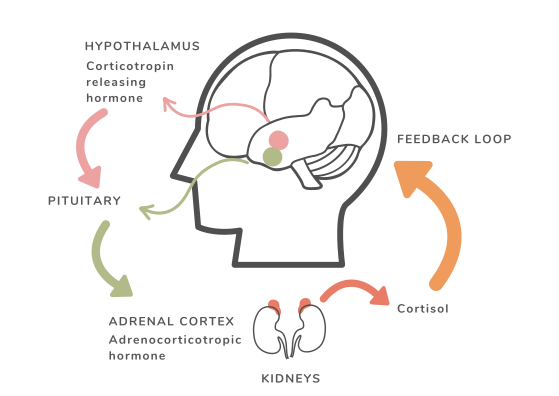
The hypothalamus is responsible for keeping the body in a state of balance, or homeostasis, by coordinating inputs between the endocrine system (hormones) and the autonomic nervous system.
The function of the hypothalamus is to regulate:
The pituitary gland, is the master gland of the endocrine system. It releases hormones and controls other endocrine glands that tell your body what to do, and when to do it. For example, the pituitary gland releases prolactin to stimulate the mammary glands to produce breast milk.
The adrenal glands (also part of the endocrine system) produce hormones that regulate metabolism, immune system, blood pressure and the stress hormone, cortisol. These glands are also linked to sympathetic and parasympathetic nervous systems.
Simply, put, when the hypothalamus responds to a stressor, it sends a message (via the corticotropin releasing hormone) to the pituitary gland, which alerts the adrenal cortex to release cortisol.
Cortisol then increases the activity of the nervous system to mobilise it into a sympathetic fight / flight response to protect us from danger, resulting in:
As seen in the diagram above, there is a feedback loop that continues to activate the processes within the HPA axis until the acute stress is over.
In states of chronic stress, the activation of the mobilised response is maintained, resulting in the ongoing release of cortisol, leading to chronically high or low levels of cortisol in the body.
Either way, the homeostasis is disrupted.
If you recall from Part 1 of the Stress Response Series, in the face of stress we will typically with fight or flight (run away or fight), or immobilisation (collapse).
1. A mobilisation (fight / flight)response would elicit:
2. An immobilisation response (collapse) response would impact:
Ultimately this leads to long term health issues that impact:
Stress is not bad for you; being stuck is bad for you.
Hobart Group Supervision Collective
A 6-month, in-person closed clinical supervision group for health professionals at the South Hobart Garden Studio. Start

Creative and Embodied Group Supervision
Online clinical group supervision for therapists, allied health and medical clinicians across Australia. Small closed group, creative and embodied process.
Header image: Marcus Woodbridge